Accelerate Your Foreign Language Skills

A few years ago, I started working as a medical intern in a hospital with only a limited understanding of Hebrew. As a doctor, you cannot hide behind a computer screen until you improve speaking in a foreign language. Every day you need to use language to communicate with your patients and other team members. It would have been better for me to learn Hebrew gradually, but sometimes life puts you in a situation where you must keep swimming to survive. And not just to keep swimming but also to do it fast. Prior to my internship, I studied only the basics of the Hebrew language at home, followed by two courses at the University of Haifa (levels B to C, non-medical Hebrew). Stepping into an intern’s job was challenging, but everything was manageable. During this experience, I learned a number of tips that can assist you in learning a foreign language faster.

1. Rethink Your Thoughts To Transform Perspective

Learning a foreign language comes with one major hurdle – being afraid of sounding stupid or slow. Mistakes are inevitable, and they are a part of the learning process, but everything improves with time. Also, I cannot guarantee that you will be as smart or fast as you are in your native language. The only thing that depends on you is thinking. Try to change your perspective because I can assure you that having a limited vocabulary in a foreign language can be advantageous. During challenging moments, I am always trying to remember what my colleague from the Hebrew class once told me: limited vocabulary may be your strength since you wouldn’t rely on medical jargon to communicate with your patients. And he was right. At that time, my knowledge of specialized terminology in a foreign language was inadequate, so I had to use simpler terms that were easier to understand for my patients, as well.

Limitations force the speaker to simplify the language and avoid using complex terms, making the language clearer for the listener. However, the ability to explain complex ideas in simple terms requires a deep understanding of the subject matter. Therefore, the newbie will expand his professional expertise by speaking a foreign language.

Albert Einstein said:

“If you can’t explain it simply, you don’t understand it well enough”

2. Protect Your Unique Story: Don’t Let Others Undermine Your Experience

I saw on the internet the meme stating, “Don’t let anybody to ruin your day. It’s your day. Ruin it by yourself”, which inspired me to reinvent it.. The message is clear: we have the power to control our own thoughts and emotions. Therefore, we shouldn’t let others dictate how we feel. Instead, we should take responsibility for our lives and not allow external factors to ruin them.

While starting to speak a new language, you must not only overcome your fears and problems with self-esteem but also overcome other people’s reactions. Most people are kind, but sometimes due to a stressful environment, personal temperament, or previous encounters with language newcomers, they may react impatiently to your progress. You may encounter both productive and unproductive criticism and sometimes receive unkind looks, but keep taking care of your business.

Back then, when I heard stories of others who had to leave their internship after internal medicine and emergency medicine cycles, I was discouraged from starting my internship early. This was due to my limited vocabulary. Despite the fear and doubt, I was grateful to have support from my family and continued with my plans which in the end were fulfilled. During my journey, I learned to be more patient and to communicate more respectfully. Now that I am aware of how it feels, I try to cut it short subtly and respectfully so I can concentrate on higher-value tasks.

3. Preparation is the key to success

As you learn the language, set a high goal to achieve maximum proficiency within a reasonable timeframe. However, there are other significant preparations you can make to support your efforts. One famous quote about the importance of preparation is attributed to the ancient Chinese military strategist Sun Tzu.

“Every battle is won before it’s ever fought.”

This quote highlights the importance of preparation and planning in any competition. It is much easier to achieve your goal when one is fully prepared and has thought through all the possible outcomes. The following are a few personal hacks you can use to improve your foreign language skills quickly.

  1. Study Relevant Documentation
    If possible, obtain and study samples of the paperwork you will encounter daily at work. For example, I studied the medical histories of my family members. Analyze the abbreviations, popular international terms, sentence structure, and conjunctions used. Practice using the correct conjunctions to improve your flow and try to adopt the style of your colleagues.
  2. Utilize Free Time for Analysis
    During any free time at work, dedicate it to analyzing available paperwork, conference materials, and presentations by your colleagues.
  3. Practice Summarization
    Try summarizing patient cases or any information you need to present, even if you don’t actually have to present it. Set limitations for yourself in terms of sentence count or time. This helps you save time, develop your sentence structure, and provides you with the opportunity to practice your newly acquired language skills.
  4. Look for Patterns
    If you are familiar with the job, you can create conversation templates with a focus on yes/no questions. This can be helpful at the beginning, but keep in mind that it may not always work. I created pre-planned templates for each body system based on patient complaints, which I used daily at work. Over time, the templates were modified to suit my needs until they no longer served me.
  5. Learn Only What You Need to Know
    When learning vocabulary, focus on terms that you’ll actually use at your work to communicate with your colleagues or to write documentation, as required. Use the internet to find lists of the most frequent words in a specific language. Here is a link for the 10,000 most commonly used words in Hebrew.
  6. Immersion is Essential
    Stop speaking in any other language and focus on communicating only in the language you’re trying to learn. My cases were always presented in Hebrew, even when I was allowed to present them in English. This was challenging, but speaking is the only way to improve your skills.

Why Does His Work Speaks for Itself Better Than Yours?

A few years ago, I attended a conference for pharmacists who specialize in working with medical cannabis. An expert on cancer and medical cannabis gave a presentation after the introductory speech. The lecture was intended for a general audience without prior experience in lab work. It is likely that he was able to secure substantial funding through his brilliant research, strong management skills, and ability to effectively deliver his ideas from brain to tongue. In addition to scientific findings of his team, his presentation was engaging in another aspect. There was a sense of confidence and persuasiveness in his presentation.

According to the presenter, his lab was capable of conducting 96 independent experiments simultaneously to test the hypothesis, namely whether Cannabis extracts inhibit tumor cell viability. His team found that Cannabis extracts with similar levels of (-)-Δ9trans-tetrahydrocannabinol (THC) had significantly different effects on tumor cell survival in vitro, and that tumors respond differently to cannabis extracts depending on their receptors [1]. It is currently mandatory to specify the route, concentration of cannabidiol and THC when prescribing medical cannabis to patients in Israel [2]. Based on this research it is critical to note, however, that even extracts with similar levels of THC affect tumor cell survival differently. As a result, more research is clearly needed to improve guidelines for prescribing cannabis for medical purposes.

So far, medical cannabis benefits are more based on the host and the product. There are no guarantees when it comes to anti-tumor properties for a specific tumor, especially with current knowledge, guidelines and products. It is no secret that products in the country are changing very rapidly. Basically, I don’t claim it works as anti-tumor agent, I don’t claim it doesn’t, but it is clear that more research is needed. For now, let’s put this aside.

However, what does it actually mean to be able to perform 96 different cell viability tests each time?

Was he right? Yes, he told the truth. Did it sound impressive to a general audience at that moment? I think so. This choice of words emphasizes repetition, adds a sense of quantity, and gives the listener a sense of trust in the data. But is it really that impressive? It’s doubtful… A simple 96-well plate is used to seed tumor cells, incubate them with viability agents, and then read them on a plate reader or using another method. Almost any Ph.D./M.S. student does these 96 experiments every day/week. Some people are naturally good at it, while others need to look carefully for ideas on how to present their work.

According to Austin Kleon in his book “Show Your Work! : 10 Ways to Share Your Creativity and Get Discovered”:

” Words matter. Artists love to trout out the tired line, ” My work speaks for itself”, but the truth is, our work doesn’t speak for itself. <…> The stories you tell about the work you do have a huge effect on how people feel and what they understand about your work affects how they value it”

I highly recommend it to anyone who needs a boost to start showing their work. Available via a link on Amazon. It was a personal recommendation, not a promotion. It’s thanks to Ali Abdaal that I got this book.

How important is it to speak up for your work?

Aside from academia, medicine, conferences, and pharmacy, we express ourselves at every job requiring human interaction. Often, we represent our workplace. Making meaningful connections, providing professional advice, and sometimes even persuading others to follow our expert advice depending on how we talk about what we do. The art of words may help us acquire funding or get published. We use it sometimes to express our appreciation to sponsors.

Recently I received an email from Technion informing me that my thank-you letter has been selected for delivery to Technion supporters for my Doctoral Fellowship in 2021/2022. Is it a big deal? Probably not, but knowing I can reach somebody to advocate for my work with a few keystrokes is pleasant. In the future, I hope that my son will be able to speak for his work or at least express himself in a way that touches other people’s souls no matter what field he chooses to pursue.

[1] Baram, L., Peled, E., Berman, P., Yellin, B., Besser, E., Benami, M., Louria-Hayon, I., Lewitus, G.M. and Meiri, D. (2019). The heterogeneity and complexity of Cannabis extracts as antitumor agents. Oncotarget, 10(41), p.4091. Available on Internet via link. Accessed on Internet [6 Feb 2023]

[2] Aviram, J., Lewitus, G.M., Vysotski, Y., Abu Amna, M., Ouryvaev, A., … & Meiri, D. (2022). The effectiveness and safety of medical cannabis for treating cancer related symptoms in oncology patients. Accepted to Frontiers in Pain Research.‬‬‬ Available on Internet via link. Accessed on Internet [6 Feb 2023].

How to Batch Process in ImageJ for Dummies?

The core of any batch-processing code consists of the following:

  • Input directory
  • Output directory – I believe in most cases it is better to save the output in a separate directory, especially when working with more complex tasks. The example below, however, does not include an output directory.
  • Loop {} – indicates repetitive actions
  • File opening
  • Manipulations
  • File saving

This macro will process all the images in the selected source directory. It opens each image, converts it to 8-bit, applies “Smooth” and “Find Edges” filters, saves the processed image as TIFF with the prefix “processed_”, and closes the image. You can modify the steps according to your needs.

// Batch Processing Macro for ImageJ

dir = getDirectory("Choose Source Directory ");
list = getFileList(dir);

for (i=0; i<list.length; i++) {
opening
  path = dir + list[i];
  open(path);
//Manipulation
  run("8-bit");
  run("Smooth");
  run("Find Edges");
// saving
  saveAs("Tiff", dir + "processed_" + list[i]);
  close();
}

To run a macro in ImageJ, follow these steps:

  1. Open ImageJ.
  2. Click the “Plugins” menu, then select “New” and then “Macro”. This will open the macro editor.
  3. Copy and paste the macro code into the editor window.
  4. Save the macro using the “File” menu and give it a descriptive name, such as “BatchProcessing.ijm”.
  5. Close the macro editor.
  6. Navigate to the “Plugins” menu, then select “Macros” and then “Run”. This will open the window where you need to find the directory and select in it the name of the macro you just saved. Choose Open.
  7. The macro will run and process the images according to the steps defined in the code.

Note: You may need to modify the macro code to fit your specific needs and input the image

Where can this be applied?

You can automate any Image J task that requires repetitive button pressing. I’ve used it to merge two different fluorescence channels for all images. Additionally, I used it to add scale bars to pictures as well as extract coordinates for wound healing analysis.

If I have no experience in coding, what should I do?

Four options are available in this case:

  • To begin with, I strongly believe you should learn how to do it. The more you understand the basics of any coding language, the more you’ll understand how computers work. Furthermore, if you explain your needs clearly to the computer, it will solve your problem more effectively. Using documentation as your vocabulary source and adapting codes posted in forums will enable you to solve your problems.
  • To create your final puzzle, you can use the macro recorder in Image J to record your steps.
  • The codes can be borrowed from other forum members, such as the one here for Image J.
  • In addition, ChatGPT, which everyone is talking about nowadays, can help you generate code templates faster without no knowledge of coding. Based on my request, ChatGPT generated the code above. Check it out. It is completely free. You can get started right away by registering here.

Commonly Overlooked Causes of Treatment Failure: Medication Scheduling

Despite living thousands of miles apart, as a doctor, I should have looked into how my mother controls her high blood pressure. Her family doctor prescribed two different medicines to regulate her blood pressure: one for the morning and another – for the evening. Apparently, the doctor’s orders were not specific enough. She used to wake up at 5 am, take her first medication, and go to work. At around 11 pm she was taking the second medicine. By this time, the first drug had been eliminated from her body, resulting in uncontrolled high blood pressure in the evenings. Luckily, a small correction in timing her medications based on their half-lives helped her to reach normal blood pressure.

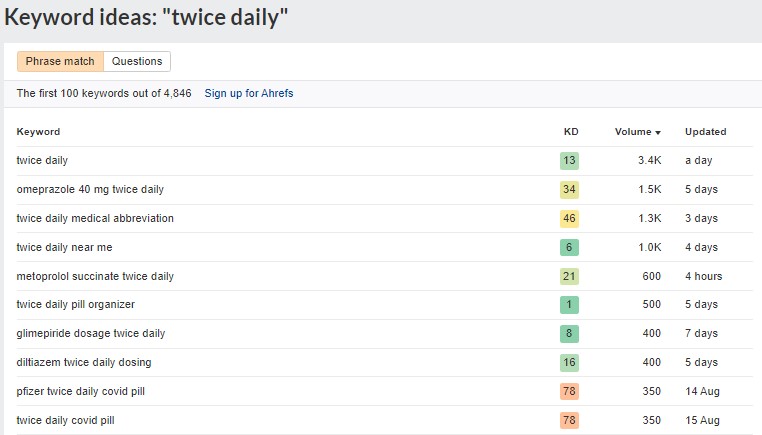
It is undeniable that our lives are very different. Some people get up at 5 am and go to bed at 11 pm, while others wake up at 8 am and fall asleep at 8 pm. Therefore, understanding when to take your medication in the mornings and when to do so in the evenings can be challenging. For a doctor, it is clear that twice daily means taking a pill approximately every 12 hours, but not for every patient. A combined average monthly number of searches for the keyword “twice daily” accounted for over six thousand healthcare-related inquiries in the United States alone.

Source: Ahrefs Free Keyword Generator

A total of seventy-two thousand people a year do not fully comprehend their doctors’ orders. This results in, patients returning to the doctor disappointed that their treatment failed, the doctor may decide to scale up their treatment with an additional drug or replace previous medications with an alternative one. It is time to raise awareness about scheduling your medications based on their half-lives to avoid over-prescribing new drugs when current therapy could have worked.

Drug half-lives: what do they mean?

A drug’s half-life indicates the time it takes for 50 percent of a drug to be eliminated from the body. The half-life of some medications can be as long as 16 hours, while others can only last up to 5 hours. Accordingly, drugs with a longer half-life will ensure a longer-lasting effect, such as lowering blood pressure. Sometimes we prefer medications with shorter half-lives because they act faster, have fewer side effects, or are easier to administer. We need to consider that different medicines can vary in their duration of action as well as in their half-lives to create a precise schedule for taking our pills.

Half-life: why you should talk to your doctor?

  • Accurate timing of your medications, based on their half-life, may help to reach desirable outcomes in your therapy. If you schedule taking your pills depending on the half-life, it will prevent gaps in your day when your symptoms could have been left untreated.
  • Correct use of your daily medications is a baseline that leads to successful treatment and better overall compliance. It is easier to stick to success than when your therapy fails.
  • Clear doctor’s orders about scheduling your daily medications would eliminate those unnecessary additional appointments to scale up the treatment by adding or replacing your current medications. It is easier to use pills correctly if you receive fewer of them.
  • If we prevent treatment failures caused by incorrect timing, this alone lets us have more different medications available for later use.

Do I need to discuss the half-life with my doctor?

Seeing your primary care physician is always a good idea, but not necessarily half-time is the cause of not successful treatment. Hence, physicians have not discussed it widely with patients. Doctors know some critical medications’ half-lives very well, but some less critical or rarer drugs may have had to check themselves. It is less likely, however, that underestimating your medication half-life is the cause of a problem when:

  • There is one medication that you take a few times a day at irregular intervals, or you take multiple medications at irregular intervals.
  • Additionally, your prescription medications did not have a clear hourly schedule.
  • Uncontrolled symptoms tend to worsen at a specific time of day, such as evenings/mornings/afternoons, regularly.

Educating your patients about half-life: when and how?

The doctor must first determine which patients would benefit from a half-life approach by asking the following questions:

  • When do you take your morning/evening medications?
  • Do you take your medications at equal intervals?
  • Does your condition worsen in the evenings or the mornings, or does it not matter?
  • If you take medications twice daily, how do you do it?

Next time you prescribe, specify the hours. You may suggest taking the medication every twelve hours when recommending it twice daily. When one drug takes longer to act and another shorter, emphasize the importance of taking them on time to ensure the best possible outcome.

How can I determine the half-life of a medication?

Clinical trials determine the half-lives of drugs before they are registered. Generally, a half-life of a particular medication can be found: