

Despite living thousands of miles apart, as a doctor, I should have looked into how my mother controls her high blood pressure. Her family doctor prescribed two different medicines to regulate her blood pressure: one for the morning and another – for the evening. Apparently, the doctor’s orders were not specific enough. She used to wake up at 5 am, take her first medication, and go to work. At around 11 pm she was taking the second medicine. By this time, the first drug had been eliminated from her body, resulting in uncontrolled high blood pressure in the evenings. Luckily, a small correction in timing her medications based on their half-lives helped her to reach normal blood pressure.
It is undeniable that our lives are very different. Some people get up at 5 am and go to bed at 11 pm, while others wake up at 8 am and fall asleep at 8 pm. Therefore, understanding when to take your medication in the mornings and when to do so in the evenings can be challenging. For a doctor, it is clear that twice daily means taking a pill approximately every 12 hours, but not for every patient. A combined average monthly number of searches for the keyword “twice daily” accounted for over six thousand healthcare-related inquiries in the United States alone.
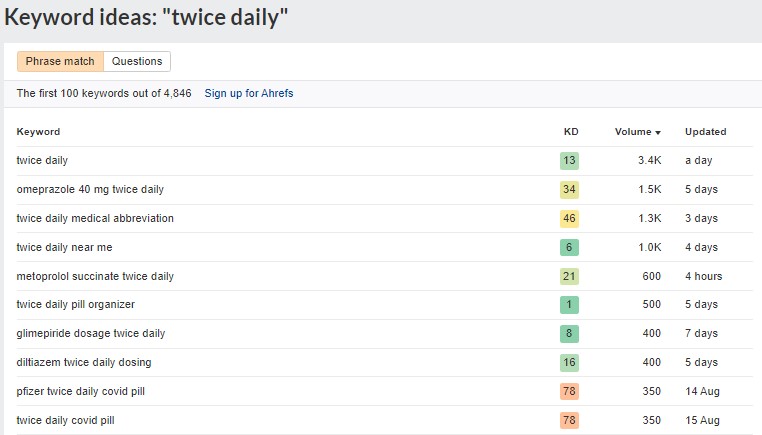
A total of seventy-two thousand people a year do not fully comprehend their doctors’ orders. This results in, patients returning to the doctor disappointed that their treatment failed, the doctor may decide to scale up their treatment with an additional drug or replace previous medications with an alternative one. It is time to raise awareness about scheduling your medications based on their half-lives to avoid over-prescribing new drugs when current therapy could have worked.
Drug half-lives: what do they mean?
A drug’s half-life indicates the time it takes for 50 percent of a drug to be eliminated from the body. The half-life of some medications can be as long as 16 hours, while others can only last up to 5 hours. Accordingly, drugs with a longer half-life will ensure a longer-lasting effect, such as lowering blood pressure. Sometimes we prefer medications with shorter half-lives because they act faster, have fewer side effects, or are easier to administer. We need to consider that different medicines can vary in their duration of action as well as in their half-lives to create a precise schedule for taking our pills.
Half-life: why you should talk to your doctor?
- Accurate timing of your medications, based on their half-life, may help to reach desirable outcomes in your therapy. If you schedule taking your pills depending on the half-life, it will prevent gaps in your day when your symptoms could have been left untreated.
- Correct use of your daily medications is a baseline that leads to successful treatment and better overall compliance. It is easier to stick to success than when your therapy fails.
- Clear doctor’s orders about scheduling your daily medications would eliminate those unnecessary additional appointments to scale up the treatment by adding or replacing your current medications. It is easier to use pills correctly if you receive fewer of them.
- If we prevent treatment failures caused by incorrect timing, this alone lets us have more different medications available for later use.
Do I need to discuss the half-life with my doctor?
Seeing your primary care physician is always a good idea, but not necessarily half-time is the cause of not successful treatment. Hence, physicians have not discussed it widely with patients. Doctors know some critical medications’ half-lives very well, but some less critical or rarer drugs may have had to check themselves. It is less likely, however, that underestimating your medication half-life is the cause of a problem when:
- There is one medication that you take a few times a day at irregular intervals, or you take multiple medications at irregular intervals.
- Additionally, your prescription medications did not have a clear hourly schedule.
- Uncontrolled symptoms tend to worsen at a specific time of day, such as evenings/mornings/afternoons, regularly.
Educating your patients about half-life: when and how?
The doctor must first determine which patients would benefit from a half-life approach by asking the following questions:
- When do you take your morning/evening medications?
- Do you take your medications at equal intervals?
- Does your condition worsen in the evenings or the mornings, or does it not matter?
- If you take medications twice daily, how do you do it?
Next time you prescribe, specify the hours. You may suggest taking the medication every twelve hours when recommending it twice daily. When one drug takes longer to act and another shorter, emphasize the importance of taking them on time to ensure the best possible outcome.
How can I determine the half-life of a medication?
Clinical trials determine the half-lives of drugs before they are registered. Generally, a half-life of a particular medication can be found:
- in the Summary of Product Characteristics (SmPC) at the website of the European Medical Agency (EMA, Annex III of specific medication)
- in the medication guide stating United States Prescribing Information (USPI) of The Food and Drug Administration (FDA)
- in the databases containing reliable information about pharmaceutical products, such as Micromedex
- in your local drug registry
 About That Health